
The Gift of Chess

Notice to commercial publishers seeking use of images from this collection of chess-related archive blogs. For use of the many large color restorations, two conditions must be met: 1) It is YOUR responsibility to obtain written permissions for use from the current holders of rights over the original b/w photo. Then, 2) make a tax-deductible donation to The Gift of Chess in honor of Robert J. Fischer-Newspaper Archives. A donation in the amount of $250 USD or greater is requested for images above 2000 pixels and other special request items. For small images, such as for fair use on personal blogs, all credits must remain intact and a donation is still requested but negotiable. Please direct any photographs for restoration and special request (for best results, scanned and submitted at their highest possible resolution), including any additional questions to S. Mooney, at bobbynewspaperblogs•gmail. As highlighted in the ABC News feature, chess has numerous benefits for individuals, including enhancing critical thinking and problem-solving skills, improving concentration and memory, and promoting social interaction and community building. Initiatives like The Gift of Chess have the potential to bring these benefits to a wider audience, particularly in areas where access to educational and recreational resources is limited.

Best of Chess Fischer Newspaper Archives
• Robert J. Fischer, 1955 ➦
• Robert J. Fischer, 1956 ➦
• Robert J. Fischer, 1957 ➦
• Robert J. Fischer, 1958 ➦
• Robert J. Fischer, 1959 ➦
• Robert J. Fischer, 1960 ➦
• Robert J. Fischer, 1961 ➦
• Robert J. Fischer, 1962 ➦
• Robert J. Fischer, 1963 ➦
• Robert J. Fischer, 1964 ➦
• Robert J. Fischer, 1965 ➦
• Robert J. Fischer, 1966 ➦
• Robert J. Fischer, 1967 ➦
• Robert J. Fischer, 1968 ➦
• Robert J. Fischer, 1969 ➦
• Robert J. Fischer, 1970 ➦
• Robert J. Fischer, 1971 ➦
• Robert J. Fischer, 1972 ➦
• Robert J. Fischer, 1973 ➦
• Robert J. Fischer, 1974 ➦
• Robert J. Fischer, 1975 ➦
• Robert J. Fischer, 1976 ➦
• Robert J. Fischer, 1977 ➦
• Robert J. Fischer, 1978 ➦
• Robert J. Fischer, 1979 ➦
• Robert J. Fischer, 1980 ➦
• Robert J. Fischer, 1981 ➦
• Robert J. Fischer, 1982 ➦
• Robert J. Fischer, 1983 ➦
• Robert J. Fischer, 1984 ➦
• Robert J. Fischer, 1985 ➦
• Robert J. Fischer, 1986 ➦
• Robert J. Fischer, 1987 ➦
• Robert J. Fischer, 1988 ➦
• Robert J. Fischer, 1989 ➦
• Robert J. Fischer, 1990 ➦
• Robert J. Fischer, 1991 ➦
• Robert J. Fischer, 1992 ➦
• Robert J. Fischer, 1993 ➦
• Robert J. Fischer, 1994 ➦
• Robert J. Fischer, 1995 ➦
• Robert J. Fischer, 1996 ➦
• Robert J. Fischer, 1997 ➦
• Robert J. Fischer, 1998 ➦
• Robert J. Fischer, 1999 ➦
• Robert J. Fischer, 2000 ➦
• Robert J. Fischer, 2001 ➦
• Robert J. Fischer, 2002 ➦
• Robert J. Fischer, 2003 ➦
• Robert J. Fischer, 2004 ➦
• Robert J. Fischer, 2005 ➦
• Robert J. Fischer, 2006 ➦
• Robert J. Fischer, 2007 ➦
• Robert J. Fischer, 2008 ➦
Chess Columns
Chessgames.com: Newspaper Chess Games Archive Chess.com: Newspaper Chess Games Archive Facebook: Bobby Fischer History Youtube: Newspaper Chess Games Archive My Life Notes lichess.org: Analyze Chess Game lichess.org: Board Editor Chess Notation Converter Chess.com: Chess Board Analysis Notes
Showing posts with label Emanuel Lasker. Show all posts

Chess Goes Other Way

Back to 1972 News Articles

The Windsor Star Windsor, Ontario, Canada Friday, June 30, 1972 - Page 22

Chess Goes Other Way
IN GOLF SOME PLAYERS do better at match, rather than stroke play. However, almost all prominent competition today is conducted at stroke play which has two main features - it rewards consistency and hurts the hot and cold competitor, and it keeps the field and more major names around longer.
Chess has gone the other way, in part at least because Bobby Fischer demanded it. And this is the principal reason Fischer, the 29-year-old American, is favored in many circles to dethrone Russia's Boris Spassky in a 24-game match starting Sunday at Reykjavik. Iceland.
Fischer, conceded by his peers the most exciting chess player in the world, decreed several years ago he would never again compete in tournament play against force of Russian numbers. He argued, and so did others, that no single Westerner could hope to win the world championship because the Russians were able to exert so much massive candidacy.
It is a simple fact that Russia mass produces more chess masters than any other country or even any group of nations. For that reason they have owned the world title for 45 years, a crushing domination broken only for three years in the middle thirties when Dr. Max Euwe, a Hollander and now head of FIDE, the ruling body, intervened between tenures of the first of great modern Russian champions, Alexander Alekhine.

FISCHER HAS LONG considered himself the best chess player in the world. It enraged and frustrated him that his ambitions for world supremacy were stymied by the FIDE system of round-robin competition which served to perpetuate Russian dominance. He called it a Communist plot hatched in Moscow.
FIDE has finally capitulated to his pleas. It allowed him to challenge through match play. Head to head, he knocked off six major qualifiers in a devastating display of mastery.

HIS FINAL OBSTACLE to getting to Spassky was Tigran Petrosian, a Russian and world champion from 1963 to 1967. He blew Petrosian off the boards last fall at Buenos Aires without difficulty.
So now it is not Russia versus Fischer, but Spassky versus Fischer. The odds have swung to Fischer, a brilliant player at the height of his powers. Spassky is 35, and in five games against Fischer has won three and drawn two. But, chess experts don't take much stock in that. In head-to-head play, Fischer is rated unbeatable by more disciples than himself.
Fischer can become the first official American world champion. The strongest American of the past was Paul Morphy who performed in the 19th century. Morphy was unofficial world champion of his time. He quit serious chess before he was 25.
The first world champion, so recognized, was William Steinitz of Vienna. Steinitz ruled for 27 years through 1893. He died in poverty, insane, on Ward's Island in 1900, having moved from Europe to the United States while still champion.

A GERMAN, DR. EMANUEL LASKER defeated Steinitz and held the crown for another 27 years. A Cuban, the all-time great Jose Capablanca succeeded Lasker. After that it was the Russians from Alekhine to Spassky with Mikhail Botvinnik, Vassily Smyslov, Mikhail Tal and Petrosian in between.
Nerves will play a major role in the matches at Reykjavik. They will play three games a week, using three other days in the week for adjourned games. The rules call for 40 moves in two and a half hours, 16 moves per hour in adjourned play. The clock is a merciless taskmaster in match chess. The unsure player often blunders against time, and if the blunder doesn't get him, the clock does by way of forfeit.

MASTER CHESS PLAYERS are notorious for the size of their egos, also for the depth of their apprehension.
The classic story on self-confidence concerns the Russian master, Efim Bogolyubov. When an admirer asked him whether he preferred the white or black pieces, he answered, “I have no preference. When I play white, I win because I have the first move. When I play black, I win because I am Bogolyubov.”
One of the best tales on apprehension would be the cigar smoking of Lasker. During a tournament, one of Lasker's opponents got him to promise he wouldn't smoke during the game. Lasker had a habit, apparently, of blowing smoke in his opponent's face.
After a few moves, Lasker took a cigar from his pocket and put it in his mouth. His opponent protested to the tournament director, saying, “Lasker agreed not to smoke.” The umpire responded. “But, he isn't. His cigar is not lit.”
Whereupon the man said. “Ah, but he threatens to smoke, and you know very well how he values a threat.”

SPASSKY IS REPUTED to possess an excellent set of nerves. No hangups are reported about him. On the contrary, Fischer has a history of wild reaction to distraction. He is wont to make all kinds of demands concerning arrangements.

THIS DOESN'T MEAN Fischer is likely to lose his cool in a tight game situation. On the contrary, his recent opponents have been the ones to lose their cool. Petrosian and two others he defeated in the eliminations wound up in hotel or hospital room seclusion suffering from nervous exhaustion.
Fischer has done nothing in his life except study chess from the age of nine. When he was 14 he actually had more experience than most chess masters twice his age.
Some observers figure Spassky is in for a nervous breakdown.

Chess Goes Other Way

Fischer Ready For Test

Back to 1972 News Articles

Calgary Herald Calgary, Alberta, Canada Wednesday, June 14, 1972 - Page 13

Fischer Ready For Test By Al Horowitz
The New York Times, Copyright, 1972
New York — When, on July 2, many-time United States chess champion Robert Fischer sits down to play the first game of his world championship match against title-holder Boris Spassky of the Soviet Union, it will be the first time in 71 years that an American has participated in a match for chessdom's highest title.
Although Samuel Reshevsky took part in a tournament held in 1948 to determine the successor to the throne left vacant by the death of Alexander Alekhine — and finished fourth — no American has faced a reigning world champ in a head-to-head confrontation for the title since Frank J. Marshall in 1901, when he suffered a humiliating defeat at the hands of Emmanuel Lasker.
Those 71 years represent a long period of hope and frustration for American chess fans, and it is little wonder the national chess community should await the event in a fever of enthusiasm.
Many American chess players have followed Fischer's career from the time when, at the age of 12, he first proved himself a force to be reckoned with. When two years later, in 1956, he won the U.S. championship for the first time, there were many who predicted that he would win the world title before he was old enough to vote. But, although he went on to become, at the age of 15, the youngest grandmaster in the history of the game, the road to the summit proved to he much longer and rockier than his admirers had anticipated.
That road has now led to, of all improbable places, Reykjavik, Iceland, where play, barring accidents, will begin July 2; the first player to score 12½ points (counting one point for a win, half-a-point to each for a draw) within the limit of 24 games will be the winner. If the match is tied at the end of 24 games, the champion will retain his title.
Spassky, at 35, is six years older than Fischer. He won the title in 1969 by besting his compatriot, Tigran Petrosian, after losing to him in his first try in 1966. Spassky was also a world championship contender while still in his teens, but, like Fischer, suffered some sobering setbacks before finally achieving his goal. He should now be at the height of his career and, under ordinary circumstances, might be expected to hold on to his crown for many years to come.
However, it is the firm opinion not only of most American experts, who might well be open to the charge of wishful thinking, but of knowledgeable people all over the world, that the world champion is a decided underdog. International Chess Federation President Dr. Max Euwe, himself a former world champion, some months ago was quoted as saying that Fischer has a “60-per-cent chance” to win the title — mighty long odds in favor of the challenger.
On what, one may reasonably ask, do the authorities base such a sanguine view of Fischer's chances? Certainly not on previous games between these two opponents: the score stands 3-0 in Spassky's favor, with two draws. A careful examination of the games they have contested, however, reveals a different picture. Their first meeting, in a tournament at Mar del Plate, Argentina in 1960, when Fischer was only 16, resulted in a wild battle in which Bobby had a winning advantage, but went astray in the complications of the play and lost.

NOT SO ONE-SIDED
Spassky's second win came in 1966, when Fischer made a mistake in an even position and then succumbed to a brilliant attack. And when Spassky again beat Fischer, at the Chess Olympics — a team event — at Siegen, East Germany, in 1970, it was largely because, with the American team losing to the Russians, Fischer tried too hard and finally over-extended himself. Surely Spassky's three wins against Fischer without a loss cannot be simply dismissed with a few glib explanations, but close analysis does indicate that their meetings have not been so one-sided as all that.
What the experts are basing their opinions on, and rightly so, are the performances of the two protagonists over the past few years. There Fischer has a big edge, as he would have even if Spassky's results were far more impressive than they are. In order to win the right to contend for the championship, Fischer had to win a series of candidates' matches against some of the strongest players in the world, and he did so in extraordinary fashion.
First, he defeated Russian grandmaster Mark Taimanov, in a match held at Vancouver, last May, by an incredible 6-0 score, unprecedented in this form of competition. Then, in August, in a match played at Denver, Colo., he defeated Bent Larsen of Denmark, widely thought to be the top player of the western world, after Fischer of course, by the same margin. And then, to top it off, he disposed of former world champion Petrosian in a match played last November in Buenos Aires, Argentina, by 6½-2½.
Meanwhile, Spassky, since winning the title, has had to he content with a series of indifferent results. His most recent appearance in a major event was in a tournament in Moscow late last year, where he finished tied for sixth — by no means a disgraceful showing in such strong company, but pallid by comparison with Fischer's extraordinary doings.
Indicative of a player's recent results is a numerical ranking system which employs a complicated formula to translate tournament and match performances into a four-digit number, and can be employed to predict future results as well. Spassky's current rating is a healthy 2,690 — anything over 2,500 indicates play at the grand-master level. Fischer's however, is 2,824 — by far the highest ever achieved.
Thus, the mathematical projections indicate that Fischer will have an easy time of it, and suggest, that the final score will be about 12½-8½ in his favor.
Chess matches, of course, are not won by reference to probably tables, but over the board. Fischer is Spassky's superior both technically — his play exhibits fewer weak spots — and temperamentally Spassky has been having personal troubles recently that have markedly affected his concentration, whereas Fischer's whole life is devoted to chess. With the qualification that a player who has once won the world championship is of course capable of beating anyone, anytime, the conclusion is inevitable: Fischer will win, and most likely win big.
Fischer is capable of every type of chess — modern, hypermodern and eclectic. In these branches, control of the centre is paramount, though hypermodern chess, paradoxically, vests the center to the antagonist.
All grandmasters agree that it is important to gain control of the center yet, the hypermodernist actually inveigles his opponent into taking control of this area. Why?
In the beginning, plans of this player are long-termed. And, he cedes and bequeaths the centre.
As play progresses, the hypermodernist's efforts are to retrieve the median area, and every effort is bent on its repossession. Once regained, the hypermodernist intends to hold on and never to part with it. It goes without saying that the more knowledgeable a player, the greater his choice and also the greater technician, the finer the play. These are Fischer's attributes.
Fischer is a great, end-game expert and he favors hypermodern chess in many wins games.
All things being equal, he is confident — and confidence wins games.

Fischer Ready For Test
Duplicates · · · · · · ·

Chess Wizard Eager to Play

Back to 1972 News Articles

The Montana Standard Butte, Montana Saturday, January 01, 1972 - Page 7

Chess Wizard Eager to Play
NEW YORK — Bobby Fischer, the 28-year-old American chess wizard, would like it best if an American city were the high bidder for next spring's world title match with Boris Spassky, 34, of the Soviet Union. His second choice would be Canada.
So far eight bids for the match have been received. Friday midnight was the deadline for offers to put up $100,000 or more for the purse. The biggest chess prize ever. Bids have been submitted by Canada, France, Iceland, Israel, Switzerland and Yugoslavia, which went in two offers. A last-minute bid came from Brooklyn on Wednesday. The winner is to get 62.5 per cent of the purse and 37.5 per cent will go to the loser.
After the bids are unsealed, both the United States Chess Federation and its Soviet counterpart must agree on the match site. Presumably the highest bidder will win the match. The deadline for this accord is Feb. 1. Fischer is expected to know the site over the weekend.
“I'd like to play in the United States because I'm used to the climate and the people and the lighting is better,” Fischer said, adding, with an enigmatic laugh:
“But I wouldn't want to play in Brooklyn. Some other American city, but not Brooklyn.”

THE BROOKLYN-BRED Fischer did not elaborate, but he is accustomed to playing his matches in such metropolitan centers as Buenos Aires and Belgrade. He earned the right to challenge Spassky, who has held the world championship since 1969, by defeating Tigran Petrosian of the Soviet Union in Buenos Aires last fall. Petrosian is a former champion.
“I'll play Spassky regardless of the site,” Fischer said. “I want the money, and I want the title even more.”
The money, he added, is very important. “I've plenty of ways to spend it, because chess is my business.”
Fischer believes his chances of taking the world title are good. “I'm looking forward to the match,” he said. “I'm definitely confident that I'll master Spassky.”
Should Fischer win the 24-game match, he would become the first American world chess champion. As it is, he is the first American challenger since the championships were instituted in 1866. Since 1951, all the champions and challengers have been Soviet players.
Although Fischer is accounted young at 28, he will not, if wins, be the youngest champion. Mikhail Tal of the Soviet Union was 23 when he gained the title in 1960. Emanuel Lasker of Germany won at 28. Fischer will be 29 on March 9.

Chess Wizard Eager to Play

Recommended Books

Understanding Chess by William Lombardy Chess Duels, My Games with the World Champions, by Yasser Seirawan No Regrets: Fischer-Spassky 1992, by Yasser Seirawan Chess Fundamentals, by Jose Capablanca Bobby Fischer Teaches Chess, by Bobby Fischer My 60 Memorable Games, by Bobby Fischer Bobby Fischer Games of Chess, by Bobby Fischer The Modern Chess Self Tutor, by David Bronstein Russians versus Fischer, by Mikhail Tal, Plisetsky, Taimanov, et al

'til the world understands why Robert J. Fischer criticised the U.S./British and Russian military industry imperial alliance and their own Israeli Apartheid. Sarah Wilkinson explains:

Bobby Fischer, First Amendment, Freedom of Speech
What a sad story Fischer was,” typed a racist, pro-imperialist colonial troll who supports mega-corporation entities over human rights, police state policies & white supremacy.
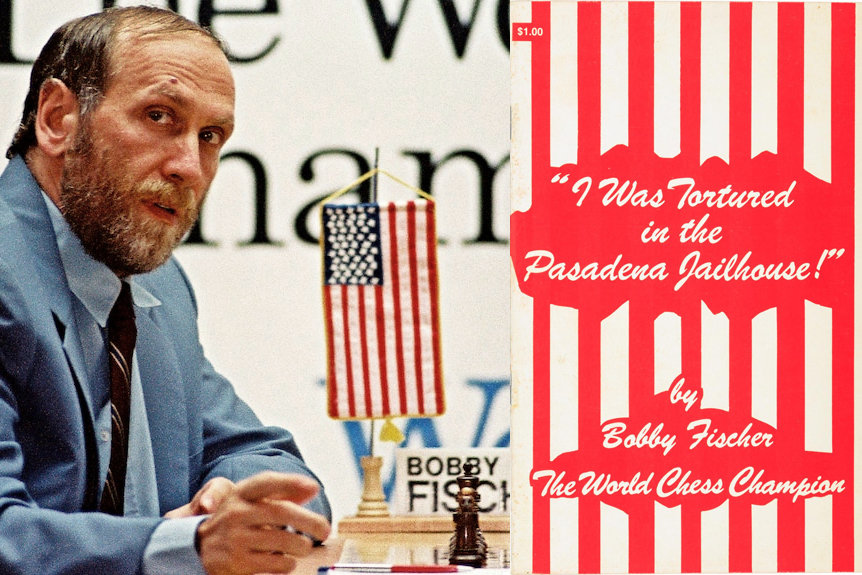
To which I replied: “Really? I think he [Bob Fischer] stood up to the broken system of corruption and raised awareness! Whether on the Palestinian/Israel-British-U.S. Imperial Apartheid scam, the Bush wars of ‘7 countries in 5 years,’ illegally, unconstitutionally which constituted mass xenocide or his run in with police brutality in Pasadena, California-- right here in the U.S., police run rampant over the Constitution of the U.S., on oath they swore to uphold, but when Americans don't know the law, and the cops either don't know or worse, “don't care” -- then I think that's pretty darn “sad”. I think Mr. Fischer held out and fought the good fight, steadfast til the day he died, and may he Rest In Peace.
Educate yourself about U.S./State Laws --
https://www.youtube.com/@AuditTheAudit/videos
After which the troll posted a string of profanities, confirming there was never any genuine sentiment of “compassion” for Mr. Fischer, rather an intent to inflict further defamatory remarks.

This ongoing work is a tribute to the life and accomplishments of Robert “Bobby” Fischer who passionately loved and studied chess history. May his life continue to inspire many other future generations of chess enthusiasts and kibitzers, alike.

Robert J. Fischer, Kid Chess Wizard 1956March 9, 1943 - January 17, 2008

The photograph of Bobby Fischer (above) from the March 02, 1956 The Tampa Times was discovered by Sharon Mooney (Bobby Fischer Newspaper Archive editor) on February 01, 2018 while gathering research materials for this ongoing newspaper archive project. Along with lost games now being translated into Algebraic notation and extractions from over two centuries of newspapers, it is but one of the many lost treasures to be found in the pages of old newspapers since our social media presence was first established November 11, 2017.

Special Thanks