The Gift of Chess

Notice to commercial publishers seeking use of images from this collection of chess-related archive blogs. For use of the many large color restorations, two conditions must be met: 1) It is YOUR responsibility to obtain written permissions for use from the current holders of rights over the original b/w photo. Then, 2) make a tax-deductible donation to The Gift of Chess in honor of Robert J. Fischer-Newspaper Archives. A donation in the amount of $250 USD or greater is requested for images above 2000 pixels and other special request items. For small images, such as for fair use on personal blogs, all credits must remain intact and a donation is still requested but negotiable. Please direct any photographs for restoration and special request (for best results, scanned and submitted at their highest possible resolution), including any additional questions to S. Mooney, at bobbynewspaperblogs•gmail. As highlighted in the ABC News feature, chess has numerous benefits for individuals, including enhancing critical thinking and problem-solving skills, improving concentration and memory, and promoting social interaction and community building. Initiatives like The Gift of Chess have the potential to bring these benefits to a wider audience, particularly in areas where access to educational and recreational resources is limited.

Best of Chess Fischer Newspaper Archives
• Robert J. Fischer, 1955 ➦
• Robert J. Fischer, 1956 ➦
• Robert J. Fischer, 1957 ➦
• Robert J. Fischer, 1958 ➦
• Robert J. Fischer, 1959 ➦
• Robert J. Fischer, 1960 ➦
• Robert J. Fischer, 1961 ➦
• Robert J. Fischer, 1962 ➦
• Robert J. Fischer, 1963 ➦
• Robert J. Fischer, 1964 ➦
• Robert J. Fischer, 1965 ➦
• Robert J. Fischer, 1966 ➦
• Robert J. Fischer, 1967 ➦
• Robert J. Fischer, 1968 ➦
• Robert J. Fischer, 1969 ➦
• Robert J. Fischer, 1970 ➦
• Robert J. Fischer, 1971 ➦
• Robert J. Fischer, 1972 ➦
• Robert J. Fischer, 1973 ➦
• Robert J. Fischer, 1974 ➦
• Robert J. Fischer, 1975 ➦
• Robert J. Fischer, 1976 ➦
• Robert J. Fischer, 1977 ➦
• Robert J. Fischer, 1978 ➦
• Robert J. Fischer, 1979 ➦
• Robert J. Fischer, 1980 ➦
• Robert J. Fischer, 1981 ➦
• Robert J. Fischer, 1982 ➦
• Robert J. Fischer, 1983 ➦
• Robert J. Fischer, 1984 ➦
• Robert J. Fischer, 1985 ➦
• Robert J. Fischer, 1986 ➦
• Robert J. Fischer, 1987 ➦
• Robert J. Fischer, 1988 ➦
• Robert J. Fischer, 1989 ➦
• Robert J. Fischer, 1990 ➦
• Robert J. Fischer, 1991 ➦
• Robert J. Fischer, 1992 ➦
• Robert J. Fischer, 1993 ➦
• Robert J. Fischer, 1994 ➦
• Robert J. Fischer, 1995 ➦
• Robert J. Fischer, 1996 ➦
• Robert J. Fischer, 1997 ➦
• Robert J. Fischer, 1998 ➦
• Robert J. Fischer, 1999 ➦
• Robert J. Fischer, 2000 ➦
• Robert J. Fischer, 2001 ➦
• Robert J. Fischer, 2002 ➦
• Robert J. Fischer, 2003 ➦
• Robert J. Fischer, 2004 ➦
• Robert J. Fischer, 2005 ➦
• Robert J. Fischer, 2006 ➦
• Robert J. Fischer, 2007 ➦
• Robert J. Fischer, 2008 ➦
Chess Columns
Chessgames.com: Newspaper Chess Games Archive Chess.com: Newspaper Chess Games Archive Facebook: Bobby Fischer History Youtube: Newspaper Chess Games Archive My Life Notes lichess.org: Analyze Chess Game lichess.org: Board Editor Chess Notation Converter Chess.com: Chess Board Analysis Notes
Showing posts with label Boris Spassky. Show all posts

Progress Seen in Negotiations For Fischer Chess Matches

Back to 1972 News Articles

The Central New Jersey Home News, New Brunswick, New Jersey, Saturday, July 01, 1972 - Page 1

Progress Seen in Negotiations For Fischer Chess Matches
Reykjavik, Iceland (AP) — Considerable progress was reported Friday night in 11th hour negotiations over Bobby Fischer's demand for more money from the world chess championship with Boris Spassky of Russia.
Officials of the sponsoring Icelandic Chess Federation met with Andrew Davis. Fischer's lawyer and confidant, but said there was still no guarantee that the 29-year-old American would show up. The 24-game match starts Sunday.
Meanwhile, Fischer missed a flight Friday to Reykjavik. He booked a reservation and checked his baggage, but after holding the plane up for two hours demanded his luggage back and disappeared from New York's Kennedy International Airport.
This apparently leaves only one flight late tonight which would put Fischer in Reykjavik in time for the start of the match.
Fischer's faith, the Church of God, observes Saturday as the Sabbath and Fischer will not fly between sundown Friday and sundown Saturday.
The financial dispute with the Icelandic Chess Federation involves Fischer's demand for 30 per cent of the gate receipts at the 2,500 Sports Palace where the matches will be held. Tickets are $5 apiece.
A federation spokesman said Davis was seeking a compromise over the money snarl.
But Gutmunder Thorarisson, ICF president who talked with Fischer's representatives in the United States for much of Friday night, said later that “nothing had been settled.”
By previous agreement, Fischer and Spassky are to divide the $125,000 purse, with the winner getting five-eighths, and receiving 30 per cent of the sales of television and film rights.
The Soviet news agency Tass blamed the uncertain condition on Fischer and said, “Wherever Fischer is, money ranks first, pushing aside all sporting motives.” ([Spoken in the true spirit of the overly ambitious Soviet empire that subsidizes its players, to achieve total monopoly, by unfair advantage, on all world sports titles to prove its “superiority,” reinforcing an illusion on the Russian people, of an almost Hitleresque “Übermensch” quality, or as they say, “It takes one, to know one.”.])

Caption: “ANGRY FISCHER— An angry Bobby Fischer rushes past admirers and away from newsmen at Kennedy Airport last night. Fischer held a reservation for a flight to Reykjavik, Iceland, but missed the flight.”

Progress Seen in Negotiations For Fischer Chess Matches
Duplicates · · ·

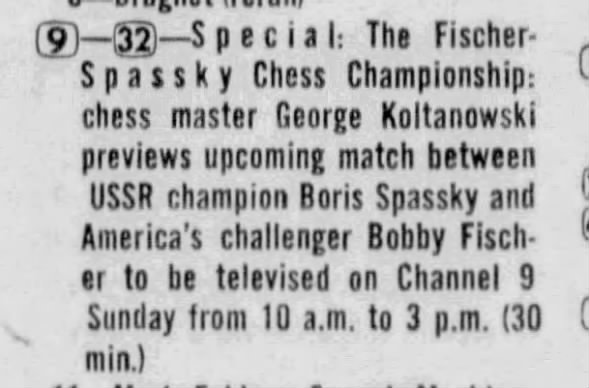
Special: The Fischer-Spassky Chess Championship

Back to 1972 News Articles

The San Francisco Examiner San Francisco, California Friday, June 30, 1972 - Page 27

Special: The Fischer-Spassky Chess Championship
Spassky Chess Championship: chess master George Koltanowski previews upcoming match between USSR champion Boris Spassky and America's challenger Bobby Fischer to be televised on Channel 9 Sunday from 10 a.m. to 3 p.m. (30 min.)

The Fischer-Spassky Chess ChampionshipThe Fischer-Spassky Chess Championship Fri, Jun 30, 1972 – 27 · The San Francisco Examiner (San Francisco, California) · Newspapers.com
Duplicates · ·

State Champ to Analyze World Chess Match

Back to 1972 News Articles

The Capital Times Madison, Wisconsin Friday, June 30, 1972 - Page 21

State Champ to Analyze World Chess Match by Peter Dorman
(Editor's Note: Peter Dorman, a U.W. graduate who now lives in Madison, is the Wisconsin state chess champion. He will contribute occasional articles to The Capital Times sports pages analyzing the world chess championship match that starts Sunday between Bobby Fischer of the U.S. and Boris Spassky of the Soviet Union.)
(Wisconsin State Chess Champion)
Sunday, July 2 is the scheduled beginning of the most dramatic contest in chess history: Bobby Fischer, former child prodigy whose play sometimes approaches absolute perfection, finally gets his crack at the world championship.
It's been a long time coming. Fischer first gained national attention in his early teens, when he won a spectacular game from Robert Byrne, one of America's best. Bobby, just 13 at the time, gave up his queen for a knight and a bishop in a long forced series of moves. A year later he won his first U.S. Championship.
Fischer's first stab at the world championship was back in 1958, when he was 15. With the death of the legendary Alexander Alekhine at the end of the Second World War, FIDE, the international chess federation, established a regular 3-year cycle for the world title. They divided the world into zones, each to hold its own championship. Then the top players would play in a worldwide interzonal tournament. The finalists from this event, plus the runners-up from the previous cycle. would compete in a candidates' tournament, and the winner of the final contest would play the reigning world champion in a 24-game match.

Mikhail Botvinnik, a Russian, became the world champion after a special tournament in 1948. He successfully defended his title against David Bronstein and Vassily Smyslov, both Russians, in 1951 and 1954. Botvinnik lost to Smyslov in 1957, but won his title back a year later in a return match.
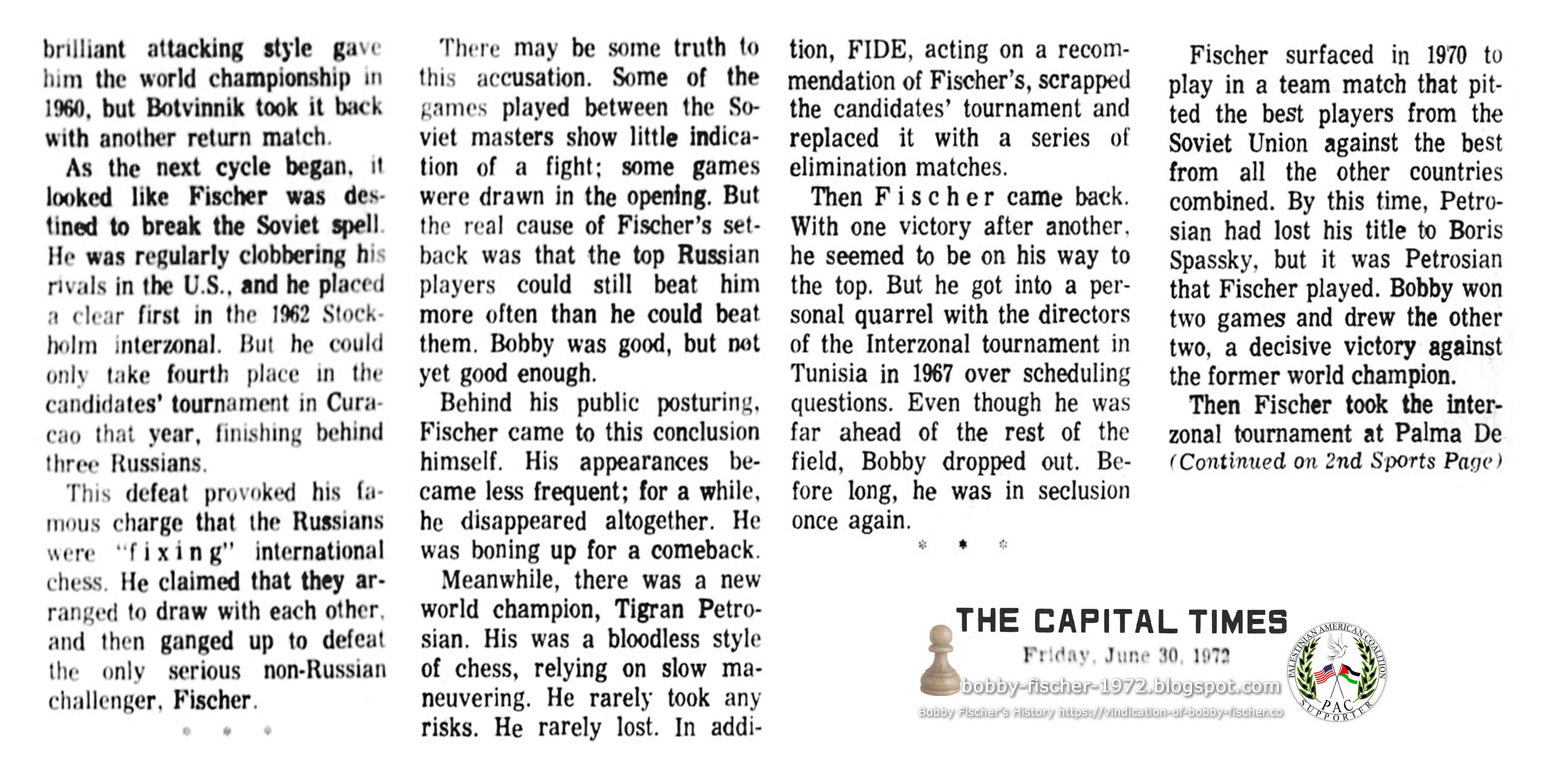
Since the U.S. Championship suits as a zonal tournament, Fischer played in the 1958 interzonal. He qualified, but fell short in the candidates tournament, which was won by Mikhail Tal—another Russian. Tal's brilliant attacking style gave him the world championship in 1960, but Botvinnik took it back with another return match.
As the next cycle began, it looked like Fischer was destined to break the Soviet spell. He was regularly clobbering his rivals in the U.S., and he placed a clear first in the 1962 Stockholm interzonal. But he could only take fourth place in the candidates' tournament in Curacao that year, finishing behind three Russians.
This defeat provoked his famous charge that the Russians were “fixing” international chess. He claimed that they arranged to draw with each other, and then ganged up to defeat the only serious non-Russian challenger, Fischer.

There may be some truth to this accusation. Some of the games played between the Soviet masters show little indication of a fight; some games were drawn in the opening. But the real cause of Fischer's set-back was that the top Russian players could still beat him more often than he could beat them. Bobby was good, but not yet good enough.
Behind his public posturing, Fischer came to this conclusion himself. His appearances became less frequent; for a while, he disappeared altogether. He was boning up for a comeback.
Meanwhile, there was a new world champion, Tigran Petrosian. His was a bloodless style of chess, relying on slow maneuvering. He rarely took any risks. He rarely lost. In addition, FIDE, acting on a recommendation of Fischer's, scrapped the candidates' tournament and replaced it with a series of elimination matches.
Then Fischer came back. With one victory after another, he seemed to be on his way to the top. But he got into a personal quarrel with the directors of the Interzonal tournament in Tunisia in 1967 over scheduling questions. Even though he was far ahead of the rest of the field, Bobby dropped out. Before long, he was in seclusion once again.

Fischer surfaced in 1970 to play in a team match that pitted the best players from the Soviet Union against the best from all the other countries combined. By this time, Petrosian had lost his title to Boris Spassky, but it was Petrosian that Fischer played. Bobby won two games and drew the other two, a decisive victory against the former world champion.
Then Fischer took the interzonal tournament at Palma De
(Continued on 2nd Sports Page)

Chess Match
(Continued from Page 1, Sports)
Mallorca, winning the last seven games in a row and finishing far ahead of everyone else. Then the elimination matches: Fischer plays Mark Taimanov, a leading Russian master, and wins six out of six. Next in line was Bent Larsen, second only to Fischer among non-Soviet players. Again, Bobby wins six out of six. Finally, Fischer faces Petrosian again, and, after a shaky start, takes the match with five wins, one loss, and three draws. These scores are particularly impressive in view of the fact that most games between the strongest players end in draws.

Now only one player stands between Fischer and the world championship: Boris Spassky. The world champion has done well against Fischer in the past: of the five games they have played, Spassky has won three and drawn two. So far, just pulling together the details of the match has been a formidable problem. Fischer wanted to play in Belgrade, Yugoslavia where he is idolized by thousands in that chess-crazy country. Belgrade had also put in the highest bid, offering cash prizes of $152,000, an unprecedented figure in tournament chess. Spassky wanted to play in Reykjavik, Iceland, where the climate is similar to that of the champion's native Leningrad.
The FIDE decision was a compromise: half of the match in Belgrade, the other half in Reykjavik. But Fischer got into a dispute with the Belgrade organizers, and the Yugoslavs pulled out. Now the entire match is slated for Iceland, with the total prize fund slightly under $100,000.
The best-of-24 game match is due to begin Sunday. Spassky is in Reykjavik, accompanied by his official “second”, Evim Geller. (In the past, Spassky's second has always been the veteran Bondarevsky. The switch is said to be caused by “difficulties”. What are they? The Russians aren't talking.) Two other companions are chess experts Krogius and Nei. Nei is also a psychologist.
Fischer complains about the lighting, which was installed to facilitate the television crews from different countries.
As of now, the match is officially on. but no one knows for sure if Fischer will blow his big chance by refusing to play at the last moment. If he does play, millions of chess fans around the world will see ten years of suspense resolved in a two-month display of unparalleled mental combat.

State Champ to Analyze World Chess Match

Absent Fischer Playing 'Nerves'?

Back to 1972 News Articles

The Atlanta Constitution Atlanta, Georgia Friday, June 30, 1972 - Page 42

Absent Fischer Playing 'Nerves'?
Reykjavik, Iceland. (NYT) — American chess grandmaster, Bobby Fischer, expected here Thursday, again failed to show up. His championship match with Boris Spassky of the Soviet Union is scheduled to begin on Sunday, but although Fischer had been booked on a flight from New York, he never boarded the plane.
There was hope, however, that he would arrive on Friday. The worried members of the Icelandic Chess Federation, who have put considerable time and money into the match, are working on that hope. In any case, Fischer will have very little time to adjust his biological clock. Spassky, for instance, arrived here June 21.
Although Fischer did not arrive on the 9 a.m. plane, another American grandmaster did. He was Larry Evans, a former U.S. champion, here as a journalist. He said that he had not been in communication with Fischer, but he expressed confidence that he would show up for the match.
“Fischer is playing a war of nerves,” Evans said. “That is my personal theory. I would not even be surprised if Fischer does not turn up until Sunday, just before the game.” ([Theory? Evans wasn't as “close” to Fischer as he too often let on in public. His “theories” usually turned out to be wrong. That's why Bobby didn't need him as a second in Buenos Aires, witnessed testifying the same when Evans walked out halfway through the tournament and returned home. Then, in 1972, whilst training for the tournament with Spassky, Miguel Quinteros, it was reported was the close friend with Fischer at Grossinger's acting as a sparring partner for Fischer's training. Evans grieved himself green over not being chosen as Fischer's #1.])
Whether or not Evans is correct, there is no doubt that Fischer's tactics have built interest in the match almost to unbearable tension.
Even the normally suave and apparently unflappable Boris Spassky may be feeling the strain.
Wednesday, he snapped at photographers and for a while there was a yelling match, in the process, Fischer is assuming mythic proportions. His name is on the lips of everybody in Reykjavik.
In the meantime, many details of the match still remain to be settled. Fred Cramer of Milwaukee, Fischer's representative here, said that Fischer and his attorney were still negotiating with the Icelandic Chess Federation and the International Chess Federation over certain demands.
For example, Fischer has asked for 30 per cent of box office receipts. The Icelandic Chess Federation is not happy about this. If Fischer gets 30 per cent, Spassky is entitled to the same, and that would not leave much for the federation, which by the time the match is over will have put up nearly $200,000. That is about a dollar for every man, woman and child in the country.
With three days to go, everything is nearly ready. But will Bobby Fischer come? Or, having come, will he play?

Absent Fischer Playing 'Nerves'?
Duplicates · · · · ·

Who Is Chess 'Bad Guy?'

Back to 1972 News Articles

Sioux City Journal Sioux City, Iowa Friday, June 30, 1972 - Page 4

Who Is Chess 'Bad Guy?'
The forthcoming chess match for the world championship between Bobby Fischer, the U.S. whiz, and Boris Spassky, the Soviet expert, is receiving what politicians would call a “good press.” At least, there has been a lot of coverage of the big event well in advance, much of it centering around Fischer's chest-beating over the playing site and so on.
We noted the other day a news article written from Moscow by an American correspondent for an Eastern newspaper. It was an interview with Spassky, whom the writer described as “quiet in manner and laconic of speech,” while portraying Fischer as the 28-year-old “enfant terrible” of the chess board.
“Bobby Fischer,” the writer explained, “is known for his brashness and bombast, and his squabble over the venue of the match and over the television and film rights has done nothing to enhance his popularity.”
Something like the old horse operas and “rassling” matches, where there's always a “good guy” and a “bad guy.” But — and this worries us a little — the good guy is supposed to win. Hopefully, this traditional pattern won't preclude the U.S. champion from check-mating the “good guy” from the U.S.S.R.

Who Is Chess 'Bad Guy?'

It Takes 2 to Play Chess & Bobby Hasn't Moved

Back to 1972 News Articles

Daily News New York, New York Friday, June 30, 1972 - Page 5

It Takes 2 to Play Chess & Bobby Hasn't Moved
By Gene Spagnoli
The continued absence of U.S. chess genius Bobby Fischer in Reykjavik, Iceland, where on Sunday he is due to begin his match against Russia's Boris Spassky for the world championship — at first attributed to temperament—might realistically be blamed on Fischer's last - minute demand for more money, informed sources said yesterday.
Fischer, 29, who canceled flight reservations last Sunday and again Wednesday, is reported to have issued an ultimatum to the Iceland Chess Federation several days ago for 30% of the gate receipts on top of the unprecedented pay-off to which he has already agreed.
Under the agreement, Fischer and Spassky will share a purse of $125,000, with the winner getting five eighths, in addition to receiving 20% apiece from the sale of television and film rights of the match.
Seemingly oblivious to Fischer's absence in Reykjavik, Spassky, who has been on the scene for the past 10 days, shrugged off the unexplained ramifications with a noncommittal, “If he doesn't come we will all go home. It's as simple as that.”
If and when he shows up, Fischer, who has been seeking the match for years, would be the first American ever to play in an official match for the world championship.
Asked precisely where Fischer was, Edmund Edmondson, executive director of the United States Chess Federation, said: “He's somewhere in the metropolitan area, but where I have no idea. I don't think that anyone will know if he will play until game time, 5 p.m. Icelandic time. He's putting on some kind of an act—for what I don't know.”
A scheduled Icelandic Airlines flight to Reykjavik left New York early today but an airline spokesman said Fischer was not aboard. Fischer was seen at the airport late last night but refused to talk to newsmen.
In Reykjavik, Chester Fox, who has the television and film rights to the championship, said: “I think Bobby will come here and I think he'll win. I saw him a couple of days ago and he's really ready—relaxed, calm and sure of himself.”
Fred Kramer of Minneapolis is acting for Fischer in Iceland. The Russians, who take their chess seriously, have sent a small squad to aid Spassky. His entourage includes two grand masters, an international master and a psychologist.
Spassky was asked recently about reports that he was demanding a room temperature of 21 degrees Centigrade —about 70 degrees Fahrenheit—while Fischer wanted 24 degrees.
Spassky said one solution would be to add 24 and 21 and divide by two.
The 24-game match—three games a week—could take two months if it runs its full course. The winner needs 12½ points.

It Takes 2 to Play Chess & Bobby Hasn't Moved
Duplicates · · · · · ·

Fischer Demands More Cash To Play Chess Champion

Back to 1972 News Articles

Pensacola News Journal Pensacola, Florida Friday, June 30, 1972 - Page 23

Fischer Demands More Cash To Play Chess Champion
Reykjavik, Iceland (AP) — Bobby Fischer has made a last-minute demand for more money to play in the world chess championship against Russian Boris Spassky, informed sources said Thursday.
They reported that the 29-year-old American challenger has sent an ultimatum to the Iceland Chess Federation “two or three days ago,” saying he would not show up unless he got 30 per cent of the gate receipts on top of the unprecedented sums already guaranteed.
Under the agreement Fischer and Spassky signed with the federation, the players will share a purse of $125,000, with the winner getting five-eighths of it. In addition it was agreed that they would each get 30 per cent of receipts from sales of television and film rights for the match.
Fischer canceled scheduled flights to Reykjavik, Tuesday and Wednesday. This had led to speculation that he was waging a war of nerves with titleholder Spassky.
The 24-game match is due to start on Sunday in a 2,500-seat sports palace where seats are sold for $5 a game.
Since receiving Fischer's new demand, Icelandic Chess Federation officials have been in almost constant touch with Fred Cramer, a former president of the American Chess Federation, acting as Fischer's advance man, the informants said.
It was learned that the Icelandic federation wanted to avoid a rupture and was seeking a compromise. Officials were said to feel the federation could not afford any additional expenses.
However, the sources said that while the federation might have trouble breaking even if the match went on as scheduled, it would not stand to lose if the match were canceled.
Lothar Schmidt, the West German chosen to referee the match, expressed shock when he was told of the stand off shortly after his arrival Wednesday, informants said. The news was conveyed to him by Fridrik Olafsson, an Icelandic grandmaster, they added.
The sources contended the deadlock over money was the main reason Fischer did not arrive from New York as expected.
One ranking American chess expert, who knows Fischer—but may not have known about the financial dispute—said he felt Fischer was waging a war of nerves against Spassky ([Evans was wrong. Again.]).

Fischer Demands More Cash To Play Chess Champion
Duplicates · · · · · · · · · · · · · · · · · · · · · · · · · · · · · · · · · · · · · · · · · · · · · · · · · · · · · · · · · · · · · · · · · · · · · ·

Fischer In Retreat

Back to 1972 News Articles

The Evening Sun Baltimore, Maryland Friday, June 30, 1972 - Page 2

Fischer In Retreat
Bobby Fischer, American chess champion, runs away from newsmen at New York's Kennedy Airport. He did not leave for Iceland, however, and his world chess championship match against Russia's Boris Spassky. The World Chess Federation is threatening Fischer with blacklisting after reports he is holding out for cut of receipts from match.

Fischer In Retreat
Duplicates · · · · ·

Fischer Threatened With Blacklisting

Back to 1972 News Articles

Journal and Courier Lafayette, Indiana Friday, June 30, 1972 - Page 26

Fischer Threatened With Blacklisting
Amsterdam (AP) — The president of the World Chess Federation has threatened American champion Bobby Fischer with blacklisting following reports he is holding out for a cut of the gate receipts from his World Series with Boris Spassky of Russia.
Dr. Max Euwe, the world federation president and veteran Dutch grandmaster, said Thursday night that if the 29-year-old American fails to appear Sunday for the start of the world chess championship in Reykjavik, Iceland, he stands to lose his rights to play for the world title “not only this time, but perhaps forever.”
Fischer was seen Thursday night at New York's Kennedy airport, but Icelandic Airlines said he did not board its flight to Reykjavik. When newsmen tried to question him, his bodyguards fended them off.
The next flight from New York to Iceland is tonight. But Fischer in the past has refused to fly on the Jewish Sabbath, between sundown Friday and sundown Saturday.
Informed sources in Reykjavik said that Fischer informed the Icelandic Chess Federation that he wouldn't play unless he got 30 per cent of the gate receipts. This would be in addition to his share of the $125,000 purse and 30 per cent of the receipts from the sales of television and film rights already agreed to.
The Icelandic federation reportedly was seeking a compromise in negotiations with Fred Cramer, former president of the American Chess Federation, who is acting as Fischer's advance man. The Icelanders said they already have spent about $200,000 on preparations, and if they meet Fischer's demand they can't break even.
The gate receipts probably will be considerable. Matches will be played three to six days a week in a 2,500-seat sports palace with seats at $5 each. And the series is expected to last two months.
Euwe said he didn't expect the Icelandic Chess Federation to meet Fischer's demand. He added that it would have grounds for legal action against the American challenger if he didn't show up Sunday.
“I don't like Mr. Fischer in our chess world,” said Euwe. “He's a good player but every day we are getting another ultimatum from him like this.”
The young American has waged a relentless campaign to push championship chess toward the financial leagues hitherto reserved for the Namaths, the Hulls and the Seavers of professional sports. It is a campaign in which he gets no cooperation from the Soviet champions, who already enjoy the status of public heroes, well subsidized by their government.

Fischer Threatened With Blacklisting
Duplicates · · · · · · · · · · · · · · · · · · · · · · · · · · · · · · · · · · · · · · · · · · · · · · · · · · · · · · · · · · · · · · · · · · · · · · · · · · · · · · · · · · · · · · · · · · · · · · · · · · · · · · · · · · · · · · · · · · · · · · · · · · · · · ·

Organizers smokescreening Bobby: “The Icelanders said they already have spent about $200,000 on preparations, and if they meet Fischer's demand they can't break even.” ([Sure, and part of the aforementioned 200K is ‘prize money’ so it wasn't ‘spent’. Second, Australia said it could pay for all preparations for a mere 25K. Thirdly, these same organizers later admit, “it would not stand to lose if the match were canceled.”])

Fischer Has Dreams of World's Chess Title

Back to 1972 News Articles

Courier-Post Camden, New Jersey Friday, June 30, 1972 - Page 12

Fischer Has Dreams of World's Chess Title By Ian Westergren
Reykjavik (UPI)—Bobby Fischer's big dream comes true Sunday when he sits down at the checkered board to play world chess champion Boris Spassky of the Soviet Union.
The American chess genius considers the 24-game world championship match a mere formality.
He has said time and again that if he just gets a shot at the 35-year-old champion, he is certain of defeating him.
Ever since he learned to play chess in Brooklyn at the age of six, the lanky American grand master, now 29, has cherished one big dream —to become the world champion in the oldest and most sophisticated of games.
If he succeeds—and there are many experts who believe he will—he will become the second American world champion in the long history of chess and the first non-Russian to rule as champion since Max Euwe of the Netherlands held the title briefly in the 1930s.
He would also pocket five-eighths of the prize money, which totals $125,000. The money was put up by the Icelandic government and the city of Reykjavik to win the right to stage the match in this unlikeliest of settings—on an island in the storm-tossed North Atlantic.
To Fischer, chess comes first. But money follows closely behind and the question of money almost ruined the championship.
Eight cities offered to stage the match: The International Chess Federation (FIDE), now run by Euwe, asked the two players to select their candidate cities. Spassky picked Reykjavik, Fischer picked Belgrade, Yugoslavia, which offered $43,000 more than Iceland.

TV Rights
FIDE then decided to compromise, playing 12 games in Belgrade and 12 in Reykjavik. Fischer objected and said he and Spassky should also get the money from the TV rights.
In the end, Belgrade organizers got tired and made a request ([an illegal demand which the USCF refused to pay]) for a guarantee of $30,000 to ensure that Fischer would turn up.
Finally FIDE presented an ultimatum to Fischer: Accept Reykjavik or lose the right to a world championship match.
At that stage, with his big dream threatened, Fischer agreed to the conditions offered by the Icelandic Chess Federation. The Icelanders, although there are only 200,000 of them, are chess-mad and the organizers say they are assured of sellout crowds of 5,000 in the Laugardals-Hoellin indoor sports arena.

Leaves Games
The crowd is another potential cause of trouble with the American challenger, who has been known to leave games because the noise of the crowd irritated him.
Fischer and Spassky, at a chess board made of white and green Icelandic stones and seated in specially constructed chairs, will be placed on the stage in the hall.
The organizers, aware of Fischer's hot temper, first suggested that a glass wall be erected between the players and the crowd. But Fischer rejected the proposal.
Other things which have come under fire from Fischer are the lighting and the ventilation in the hall and the choice of German grand master Lothar Schmid as umpire.

24 Games
However, Icelandic chess officials are satisfied that Fischer will accept the arrangements. They were not even worried when Fischer abruptly decided to change his arrival date. “We are satisfied he will be here in time,” they said.
The games will be played Sundays, Tuesdays and Thursdays with adjourned games being finished on Mondays, Wednesdays and Fridays.
The match is scheduled for 24 games, but as is customary in world championship play, the remaining games will be canceled when one of the two has reached 12.5 points or more. The players get one point for a win and half a point for a draw.
To retain his title, Spassky needs only 12 points—a draw. To win the title, Fischer will have to score 12.5 points or more.
Under the FIDE rules, Fischer and Spassky must make 40 moves in two and a half hours. If the game is still undecided then, it will be adjourned and finished later with both required to make 16 moves an hour. A player running out of time forfeits the game.
While Fischer has predicted an easy victory, Spassky has refused to speculate about the match.
Spassky, who won the title in 1969 from fellow countryman Tigran Petrosian, is the favorite of Danish grand master Bent Larsen.
Larsen, who was defeated by Fischer in the elimination for the Reykjavik match and served as Fischer's adviser at one time, feels Spassky's experience from two previous world championship games and his better nerves will be decisive.

Aggressive Player
“Fischer is a genius, an aggressive player who fights as long as there is a pawn left on the board,” Larsen said. “But if I have to pick a favorite, I would pick Spassky because of his routine and better nerve control.”
Spassky has paid tribute to Fischer, whom he described as “a remarkable chess player. Without him the world of chess would be very dull.”
While Fischer goes on attack to win every game and is thrown off balance by a draw, Spassky has proved in previous matches that he can come back from a series of drawn games to score decisive wins.
They have met five times before, with Spassky winning three games and drawing two.
But the Russian, who leads a comfortable life on his earnings as a professional chess player, agrees that Fischer has got more fire.
Spassky told Western correspondents he would rather be at home in Moscow with his family and friends “sharing some wine and playing chess for fun” than competing for the world title in Reykjavik.
To Fischer chess is almost everything, and Spassky says he does not understand his obsession. “I would like to teach Bobby that there are other things than chess in life.”

Fischer Has Dreams of World's Chess Title
Duplicates · · · · · · · · · · · · · · · ·

World Title Match in Secret

Back to 1972 News Articles

The Times Munster, Indiana Sunday, July 02, 1972 - Page 46

World Title Match in Secret
New York (UPI)—The more Bobby Fischer thinks about it the more it bugs him.
Why Reykjavik, Iceland?
“Why not Rome?” Fischer would like to know.
“Why not Paris, Oslo, Zurich, Dallas or New York? Or even Moscow? Any large city where there's people, activity and decent restaurants would be fine. Some place at least where there's something to do at night.”
Bobby Fischer, America's 29-year-old chess genius, has a theory about why Reykjavik was picked as the site of the world championship which starts this Sunday.
The Russians are the ones who picked Reykjavik.
Fischer thinks the Russians have a motive.

HE THINKS they want to “hide” the championship because he feels he's going to take it from the Soviet Union's Boris Spassky. What's more, Fischer thinks the Russians know he's going to do it.
In this own way, Fischer is a demonstrator.
He has been demonstrating the way he feels about having to play in Reykjavik by taking his good old time getting there.
This has shaken up a lot of people but Fischer had a reason for his actions. Call it oneupsmanship if you like.
Boris Spassky needn't worry about Fischer not making it for their first match though.

BOBBY HULL may or may not play for the Winnipeg Jets next season and Rick Barry may or may not play for the Golden State Warriors, but there is no way Bobby Fischer ever is going to miss playing for the world championship of chess. Even in Reykjavik.
Mainly because he thinks he's going to win.
I wouldn't be at all surprised if he's right, and that has nothing to do with chauvinism.
Spassky is good, but Fischer is better, and when the tall, curly-haired New Yorker is right, he's like Joe Frazier and Tom Seaver when they're right. Meaning nobody's going to beat him.
Fischer doesn't hold back.
He is exceptionally outspoken and honest, and when you hear his objections to playing in Reykjavik, they do make a good deal of sense.
Fischer has been there, so when he talks about Reykjavik he isn't doing so from hearsay but from personal experience. He says there is so little to do there, particularly at night, a guy can go out of his ever-loving mind.

NOT THAT Fischer is a rounder. If anything, he's much more of a loner, but there are times he would like to become part of the general mix, or at least observe it, and how can he possibly do that when there is no general mix?
He also says the television coverage will be limited. If he beats Spassky, he doesn't see why it should be some kind of secret.
Fischer originally planned to go to the world championships with only one other person; Spassky is already in Reykjavik with what amounts to an entourage. Fischer reads significance into that also because the championship goes on for some time and while Spassky will have people to talk to and help him relax, Fischer won't.
Fischer doesn't think any of these things are pure accidents. He sees them all as part of a general program by the Soviets to try to beat him psychologically.

THE WORLD champion has the right to pick the site of the championships,” says Fischer.
“Spassky wasn't even there when the international governing body chose the site. A Russian delegation was there and they picked the site.”
Fischer feels the championships have become a political matter. That annoys him.
But it hasn't lessened any of his desire to beat Spassky. Fisher has a lot of that same “killer instinct” Jack Dempsey had when he was fighting. Some of that instinct shows up even when he's not sitting at the chess board.
Earlier this month, for example, he competed with 15 other top athletes in the Dewars Sports Celebrity tennis championships at LaCosta, Calif., and it was a little funny to watch such headliners as Rick Barry, Deacon Jones and Elgin Baylor all ask Fischer for his autograph.

IN THE FINALS of the tournament, Hank Greenberg, the baseball Hall of Famer, and Bob Boyd, the basketball coach at Southern California, beat 0. J. Simpson and Gail Goodrich for the title. Bobby Fischer was among the losers. “Next year,” he said. “I'm going to win.” He said it as if he meant it, too.

World Title Match in Secret
Duplicates · · · · · · · · · · · · · · · · · · · · · · · · · · · · · · · · · · · · · · · · · · · ·

Chess Pros Boris Spassky and Bobby Fischer

Back to 1972 News Articles

Arizona Republic Phoenix, Arizona Friday, June 30, 1972 - Page 17

Chess Pros Boris Spassky and Bobby Fischer
Chess pros Boris Spassky, left, of the Soviet Union and Bobby Fischer of the United States ponder moves at matches.

Chess Pros Boris Spassky and Bobby Fischer
Duplicates · ·

Fischer Hides, May Seek Bigger Purse

Back to 1972 News Articles

The Pittsburgh Press Pittsburgh, Pennsylvania Friday, June 30, 1972 - Page 21

Fischer Hides, May Seek Bigger Purse
By Philip Finn
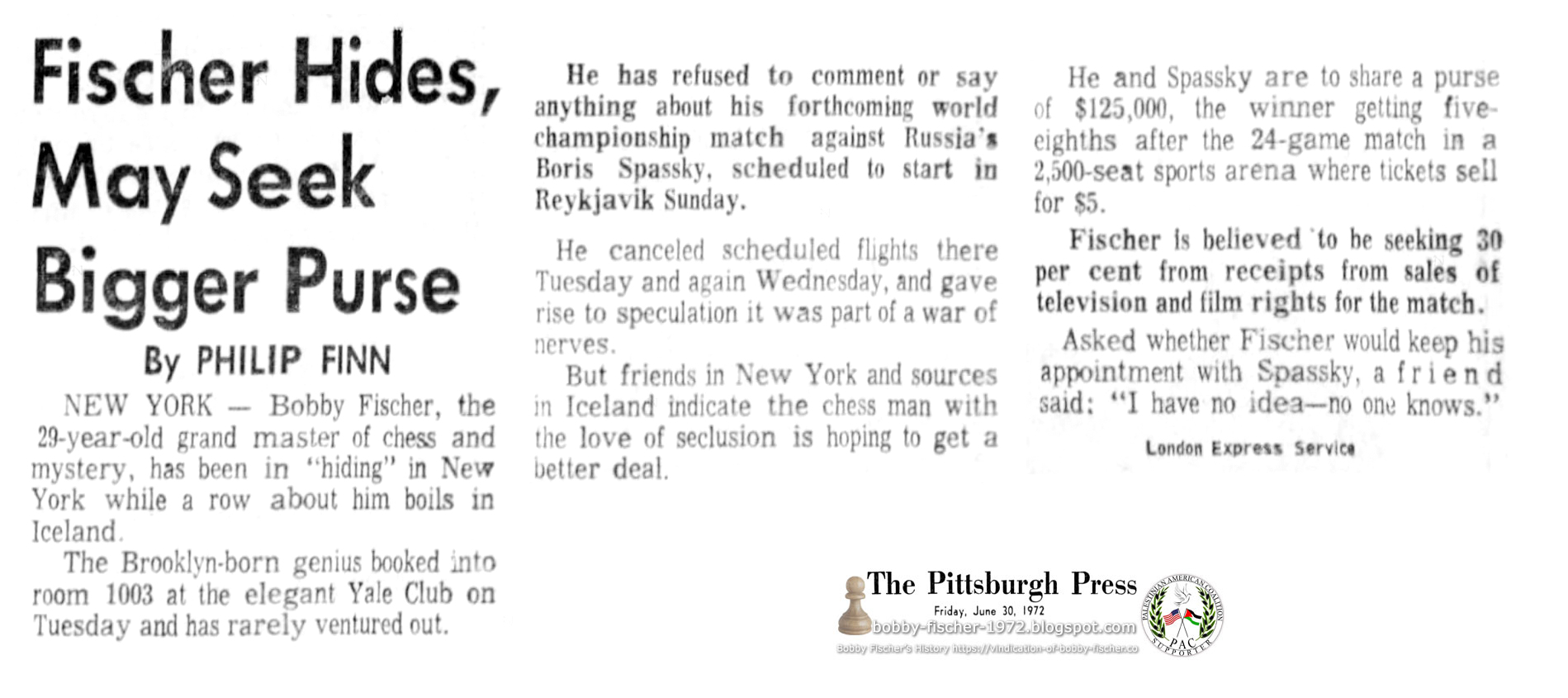
New York — Bobby Fischer, the 29-year-old grand master of chess and mystery, has been in “hiding” in New York while a row about him boils in Iceland.
The Brooklyn-born genius booked into room 1003 at the elegant Yale Club on Tuesday and has rarely ventured out.
He has refused to comment or say anything about his forthcoming world championship match against Russia's Boris Spassky, scheduled to start in Reykjavik Sunday.
He canceled scheduled flights there Tuesday and again Wednesday, and gave rise to speculation it was part of a war of nerves. But friends in New York and sources in Iceland indicate the chess man with the love of seclusion is hoping to get a better deal.
He and Spassky are to share a purse of $125,000, the winner getting five-eighths after the 24-game match in a 2,500-seat sports arena where tickets sell for $5.
Fischer is believed to be seeking 30 per cent from receipts from sales of television and film rights for the match.
Asked whether Fischer would keep his appointment with Spassky, a friend said: “I have no idea—no one knows.”
London Express Service

Fischer Hides, May Seek Bigger Purse

Man To Beat

Back to 1972 News Articles

The Pittsburgh Press Pittsburgh, Pennsylvania Friday, June 30, 1972 - Page 21

Man To Beat
Boris Spassky, hero of Russia's national sport with “a great deal more to lose than Fischer” in Iceland, meets the press with Soviet international chess master Jivo Nei, left, and interpreter.

Man To Beat

Chess Goes Other Way

Back to 1972 News Articles

The Windsor Star Windsor, Ontario, Canada Friday, June 30, 1972 - Page 22

Chess Goes Other Way
IN GOLF SOME PLAYERS do better at match, rather than stroke play. However, almost all prominent competition today is conducted at stroke play which has two main features - it rewards consistency and hurts the hot and cold competitor, and it keeps the field and more major names around longer.
Chess has gone the other way, in part at least because Bobby Fischer demanded it. And this is the principal reason Fischer, the 29-year-old American, is favored in many circles to dethrone Russia's Boris Spassky in a 24-game match starting Sunday at Reykjavik. Iceland.
Fischer, conceded by his peers the most exciting chess player in the world, decreed several years ago he would never again compete in tournament play against force of Russian numbers. He argued, and so did others, that no single Westerner could hope to win the world championship because the Russians were able to exert so much massive candidacy.
It is a simple fact that Russia mass produces more chess masters than any other country or even any group of nations. For that reason they have owned the world title for 45 years, a crushing domination broken only for three years in the middle thirties when Dr. Max Euwe, a Hollander and now head of FIDE, the ruling body, intervened between tenures of the first of great modern Russian champions, Alexander Alekhine.

FISCHER HAS LONG considered himself the best chess player in the world. It enraged and frustrated him that his ambitions for world supremacy were stymied by the FIDE system of round-robin competition which served to perpetuate Russian dominance. He called it a Communist plot hatched in Moscow.
FIDE has finally capitulated to his pleas. It allowed him to challenge through match play. Head to head, he knocked off six major qualifiers in a devastating display of mastery.

HIS FINAL OBSTACLE to getting to Spassky was Tigran Petrosian, a Russian and world champion from 1963 to 1967. He blew Petrosian off the boards last fall at Buenos Aires without difficulty.
So now it is not Russia versus Fischer, but Spassky versus Fischer. The odds have swung to Fischer, a brilliant player at the height of his powers. Spassky is 35, and in five games against Fischer has won three and drawn two. But, chess experts don't take much stock in that. In head-to-head play, Fischer is rated unbeatable by more disciples than himself.
Fischer can become the first official American world champion. The strongest American of the past was Paul Morphy who performed in the 19th century. Morphy was unofficial world champion of his time. He quit serious chess before he was 25.
The first world champion, so recognized, was William Steinitz of Vienna. Steinitz ruled for 27 years through 1893. He died in poverty, insane, on Ward's Island in 1900, having moved from Europe to the United States while still champion.

A GERMAN, DR. EMANUEL LASKER defeated Steinitz and held the crown for another 27 years. A Cuban, the all-time great Jose Capablanca succeeded Lasker. After that it was the Russians from Alekhine to Spassky with Mikhail Botvinnik, Vassily Smyslov, Mikhail Tal and Petrosian in between.
Nerves will play a major role in the matches at Reykjavik. They will play three games a week, using three other days in the week for adjourned games. The rules call for 40 moves in two and a half hours, 16 moves per hour in adjourned play. The clock is a merciless taskmaster in match chess. The unsure player often blunders against time, and if the blunder doesn't get him, the clock does by way of forfeit.

MASTER CHESS PLAYERS are notorious for the size of their egos, also for the depth of their apprehension.
The classic story on self-confidence concerns the Russian master, Efim Bogolyubov. When an admirer asked him whether he preferred the white or black pieces, he answered, “I have no preference. When I play white, I win because I have the first move. When I play black, I win because I am Bogolyubov.”
One of the best tales on apprehension would be the cigar smoking of Lasker. During a tournament, one of Lasker's opponents got him to promise he wouldn't smoke during the game. Lasker had a habit, apparently, of blowing smoke in his opponent's face.
After a few moves, Lasker took a cigar from his pocket and put it in his mouth. His opponent protested to the tournament director, saying, “Lasker agreed not to smoke.” The umpire responded. “But, he isn't. His cigar is not lit.”
Whereupon the man said. “Ah, but he threatens to smoke, and you know very well how he values a threat.”

SPASSKY IS REPUTED to possess an excellent set of nerves. No hangups are reported about him. On the contrary, Fischer has a history of wild reaction to distraction. He is wont to make all kinds of demands concerning arrangements.

THIS DOESN'T MEAN Fischer is likely to lose his cool in a tight game situation. On the contrary, his recent opponents have been the ones to lose their cool. Petrosian and two others he defeated in the eliminations wound up in hotel or hospital room seclusion suffering from nervous exhaustion.
Fischer has done nothing in his life except study chess from the age of nine. When he was 14 he actually had more experience than most chess masters twice his age.
Some observers figure Spassky is in for a nervous breakdown.

Chess Goes Other Way

Recommended Books

Understanding Chess by William Lombardy Chess Duels, My Games with the World Champions, by Yasser Seirawan No Regrets: Fischer-Spassky 1992, by Yasser Seirawan Chess Fundamentals, by Jose Capablanca Bobby Fischer Teaches Chess, by Bobby Fischer My 60 Memorable Games, by Bobby Fischer Bobby Fischer Games of Chess, by Bobby Fischer The Modern Chess Self Tutor, by David Bronstein Russians versus Fischer, by Mikhail Tal, Plisetsky, Taimanov, et al

'til the world understands why Robert J. Fischer criticised the U.S./British and Russian military industry imperial alliance and their own Israeli Apartheid. Sarah Wilkinson explains:

Bobby Fischer, First Amendment, Freedom of Speech
What a sad story Fischer was,” typed a racist, pro-imperialist colonial troll who supports mega-corporation entities over human rights, police state policies & white supremacy.
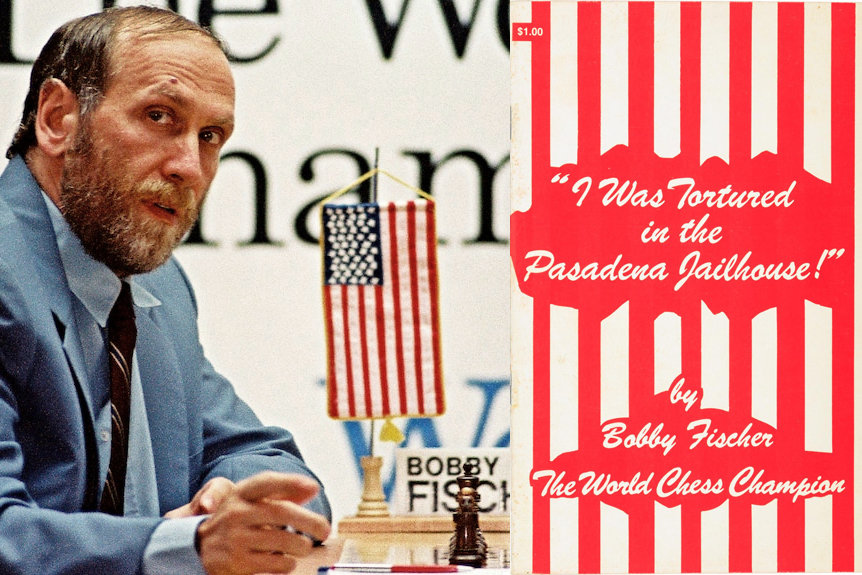
To which I replied: “Really? I think he [Bob Fischer] stood up to the broken system of corruption and raised awareness! Whether on the Palestinian/Israel-British-U.S. Imperial Apartheid scam, the Bush wars of ‘7 countries in 5 years,’ illegally, unconstitutionally which constituted mass xenocide or his run in with police brutality in Pasadena, California-- right here in the U.S., police run rampant over the Constitution of the U.S., on oath they swore to uphold, but when Americans don't know the law, and the cops either don't know or worse, “don't care” -- then I think that's pretty darn “sad”. I think Mr. Fischer held out and fought the good fight, steadfast til the day he died, and may he Rest In Peace.
Educate yourself about U.S./State Laws --
https://www.youtube.com/@AuditTheAudit/videos
After which the troll posted a string of profanities, confirming there was never any genuine sentiment of “compassion” for Mr. Fischer, rather an intent to inflict further defamatory remarks.

This ongoing work is a tribute to the life and accomplishments of Robert “Bobby” Fischer who passionately loved and studied chess history. May his life continue to inspire many other future generations of chess enthusiasts and kibitzers, alike.

Robert J. Fischer, Kid Chess Wizard 1956March 9, 1943 - January 17, 2008

The photograph of Bobby Fischer (above) from the March 02, 1956 The Tampa Times was discovered by Sharon Mooney (Bobby Fischer Newspaper Archive editor) on February 01, 2018 while gathering research materials for this ongoing newspaper archive project. Along with lost games now being translated into Algebraic notation and extractions from over two centuries of newspapers, it is but one of the many lost treasures to be found in the pages of old newspapers since our social media presence was first established November 11, 2017.

Special Thanks